
Ildong Pharmaceuticals SWOT Analysis

Fully Editable
Tailor To Your Needs In Excel Or Sheets
Professional Design
Trusted, Industry-Standard Templates
Pre-Built
For Quick And Efficient Use
No Expertise Is Needed
Easy To Follow

Ildong Pharmaceutical SWOT: A Clear, Student-Friendly Overview
Ildong Pharmaceutical is a South Korean company that researches, develops, manufactures, and sells prescription and over – the – counter medicines, with strengths in gastroenterology, cardiovascular care, and infectious disease treatments. Its advantages include a strong domestic market position, a growing biosimilars pipeline, and strategic R&D partnerships; challenges include margin pressure from generics, regulatory risks, an aging product lineup, and reliance on the Korean market. This full SWOT analysis explains those points in plain language, shows practical implications, and provides research-backed insights to help students, investors, and strategists understand the company and decide what to explore next.
Strengths

Dominant OTC Market Presence
Ildong holds a dominant share in South Korea's OTC market, led by Aronaamin vitamin with estimated annual sales of about KRW 120 billion in 2024, giving steady cash flow and strong repeat purchase rates.
High brand recognition drives loyalty-Aronaamin's penetration in adults 30-59 exceeds 40%-making it hard for rivals to displace.
The company leverages trust to roll out supplements; new launches in 2023-24 added ~8% to OTC revenue and expanded reach into younger demographics.
Strategic Global R&D Partnerships
Ildong Pharmaceuticals has proven skill in high-value global alliances, notably its 2023 co-development and licensing deal with Shionogi for the antiviral Xocova (molnupiravir variant), which included milestone payments of up to $60m and shared Phase II/III financing. These partnerships cut Ildong's clinical risk, speed drug timelines, and boosted export channels-international revenue rose 18% in 2024 on partnered products-strengthening its technical reputation and market access.

Strong Brand Heritage and Trust
With over 60 years in Korea's healthcare market, Ildong Pharmaceuticals has built institutional trust-reflected in a 2024 domestic prescription share of ~3.8%-that eases entry into new therapeutic areas and boosts success in hospital procurement, where legacy relationships cut purchase lead times by months; this long-standing presence raises the barrier to entry for newer domestic rivals and supports steady OTC revenue (KRW 220 billion in 2024), reinforcing competitive resilience.

Diversified Therapeutic Portfolio
Ildong Pharmaceuticals holds a balanced product mix across gastroenterology, cardiovascular, and infectious-disease drugs, with chronic-therapy sales making up about 62% of prescription revenue in 2024, insulating it from single-market shocks.
This diversification supported stable top-line performance: 2024 revenue was KRW 542 billion, up 3.4% year-over-year, driven by steady demand for chronic-care prescriptions.
Here's the quick math: chronic prescriptions ≈ KRW 336 billion (62% of 542b), keeping cashflows predictable.
- 62% of 2024 prescription revenue from chronic therapies
- 2024 revenue KRW 542 billion (+3.4% YoY)
- Revenue spread across gastro, cardio, infectious segments
Advanced Manufacturing Infrastructure
Ildong Pharmaceuticals runs KGMP-certified plants and other global-standard facilities, enabling efficient production of proprietary drugs and premium generics.
Automated lines cut unit costs; management reported a 12% manufacturing cost reduction in 2024 and a 25% increase in output capacity for exports year-over-year.
Ildong: Stable OTC core, 62% chronic revenue, +18% intl growth, -12% manufacturing costs
Ildong's strong OTC franchise (Aronaamin ≈ KRW 120b 2024) and 60+ year domestic trust drive repeat sales and ease hospital procurement; 2024 revenue KRW 542b (+3.4% YoY) with chronic prescriptions ≈ KRW 336b (62%). Global partnerships (eg, 2023 Shionogi deal, $60m milestones) lifted international sales +18% in 2024. KGMP plants cut manufacturing costs 12% in 2024 and raised export capacity 25% YoY.
| Metric | 2024 |
|---|---|
| Total revenue | KRW 542b |
| Aronaamin sales | KRW 120b |
| Chronic prescriptions | KRW 336b (62%) |
| Intl revenue growth | +18% |
| Manufacturing cost cut | -12% |
| Export capacity growth | +25% YoY |
What is included in the product
 Detailed Word Document
Provides a clear SWOT framework analyzing Ildong Pharmaceuticals's internal capabilities, market strengths, growth drivers, operational weaknesses, strategic opportunities in therapeutics and global expansion, and external threats such as regulatory changes, competition, and pricing pressures.

 Customizable Excel Spreadsheet
Provides a concise SWOT snapshot of Ildong Pharmaceuticals for quick strategic alignment, ideal for executives needing a high-level view to guide product, R&D, and market decisions.
Weaknesses

Sustained High R&D Expenditures
Ildong has consistently spent high R&D: in 2024 R&D outlays were 18.7% of revenue (KRW 132.4bn), which compressed operating margin to 3.2% that year. While vital for pipeline growth, these investments caused net losses in 2019 and a near-breakeven 2022, and investors flag the burn rate when clinical timelines slip - e.g., phase III delays in 2023 pushed expected commercial revenue from 2025 to 2027.
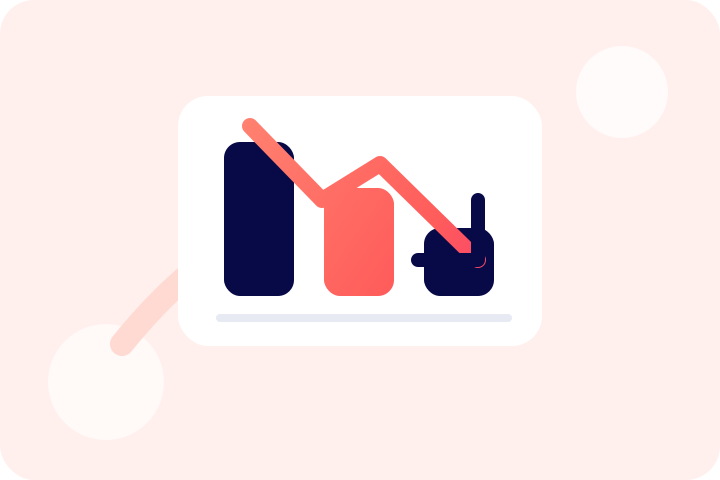
Heavy Domestic Market Concentration
About 75% of Ildong Pharmaceuticals' FY2024 revenue came from South Korea, leaving the firm highly exposed to local GDP shifts and regulatory moves such as the 2023 Korean drug pricing reform that cut reimbursements by ~3-5% for some categories.
This domestic concentration constrains growth versus peers: multinational rivals report 40-60%+ non – Korea sales, while Ildong's international share remained ~25% in 2024.
Without direct sales networks in the US and EU, Ildong relies on third – party distributors abroad, which reduced realized margins on exported products by an estimated 2-4 percentage points in 2024.
Elevated Debt-to-Equity Levels
As of FY2024 Ildong Pharmaceuticals carried a debt-to-equity ratio near 1.8x, reflecting heavy borrowings to fund its KRW 240 billion R&D plan and 2023-24 plant upgrades; rising global rates and a potential 5-10% revenue dip could strain free cash flow and push interest coverage toward critical levels. Managing repayments while preserving R&D spend is a narrow path for management and could pressure the firm's credit rating.

Dependency on Licensed Products
- Licensed products ≈28% of 2024 prescription sales
- Royalties ≈5-7% of revenue in 2024
- License loss could cut ~15% of prescription sales
Limited Direct Global Distribution
Unlike larger multinationals, Ildong Pharmaceuticals lacks an extensive proprietary global distribution network for its innovative drug candidates, limiting direct market reach and pricing control.
As of 2025 Ildong reports ~20% of revenue from licensing and partnership deals; out-licensing boosts cash but forfeits downstream margins that could add 30-50% to product lifetime value.
Building independent international sales would likely require $200-400M and 3-5 years for infrastructure, regulatory, and commercial scale-capital and time Ildong has not fully committed to.
- Relies on out-licensing; ~20% FY2025 revenue from deals
- Potential lost downstream margin: ~30-50%
- Estimated build cost: $200-400M; 3-5 years
High R&D burn and domestic dependence squeeze margins; delays, 1.8x D/E raise risk
High R&D burn (18.7% rev, KRW132.4bn in 2024) compressed operating margin to 3.2% and caused past net losses; phase III delays pushed key launches from 2025 to 2027. FY2024 revenue 75% Korea exposure; licensing/out – licensing (~28% prescription sales; ~20% total 2025) and royalties (5-7% rev) limit margins. Debt/equity ~1.8x risks cashflow under rate rises.
| Metric | 2024/2025 |
|---|---|
| R&D | 18.7% rev (KRW132.4bn) |
| Domestic sales | 75% rev |
| Licensed sales | 28% prescription |
| Royalties | 5-7% rev |
| D/E | ~1.8x |
Full Version Awaits
Ildong Pharmaceuticals SWOT Analysis
This is the actual SWOT analysis document you'll receive upon purchase-no surprises, just professional quality. The preview below is taken directly from the full SWOT report you'll get; buy now to unlock the complete, editable version with in-depth insights on Ildong Pharmaceuticals' strengths, weaknesses, opportunities, and threats.

Opportunities

Expansion into Metabolic Disease Treatments
The global diabetes population hit 578 million in 2024 and is forecast to reach 643 million by 2030, while obesity affects 1.4 billion adults in 2025, creating a large addressable market for Ildong's metabolic pipeline.
If Ildong captures 0.5% of the combined diabetes and obesity therapy market-estimated at $250 billion in 2025-that implies roughly $1.25 billion annual revenue potential.
Success with next – gen GLP/GIP or oral metabolic agents would shift Ildong from a Korea – centric firm to a global metabolic player, boosting R&D valuation and partnering leverage.
Growth in Nutraceuticals and Wellness
Post-pandemic demand for preventative care lifted global nutraceutical sales 9.8% CAGR 2019-2024 to about $520B in 2024, so Ildong can scale Aronaamin beyond its 2024 domestic OTC revenue (~KRW 120B) into higher-margin supplements.
Developing targeted probiotics matches Korea's functional food growth (2024 market ~KRW 6.2T) and shorter launches-often 6-12 months vs. 3-5 years for drugs-boosting cash flow.
Higher gross margins (supplements often 55-65% vs. 30-40% for prescriptions) could raise Ildong's group EBITDA margin by 2-4 percentage points if Aronaamin/probiotics reach 5-8% of sales within 3 years.

Global Licensing of New Drug Candidates
As Ildong's R&D candidates advance, global out-licensing could generate large upfronts and milestones; comparable Korea-origin deals averaged $50-150M upfront plus $300-800M in milestones in 2023-24, suggesting material funding for further research.
Digital Healthcare and AI Integration
Ildong can cut R&D timelines and costs by adopting AI-driven drug discovery; studies show AI reduced candidate screening time by up to 70% and drug development costs by ~30% in pilot programs through 2024.
Digital therapeutics open new prescription-adjacent products and payor reimbursement routes; global DTx market reached $5.3B in 2024, growing ~20% YoY.
Remote patient monitoring platforms could add service revenue and stickiness-chronic care RPM programs saw 8-12% better adherence and lowered hospitalization rates in 2023 pilots.
- AI: -70% screening time, -30% cost (pilot data)
- DTx market: $5.3B (2024), +20% YoY
- RPM: 8-12% adherence gains, fewer hospitalizations
Rising Demand from Aging Populations
South Korea's 2025 median age reached about 44.7 years and 20% of the population is 65+, driving higher demand for geriatric and chronic-care medicines.
Ildong Pharmaceuticals' portfolio-strong in cardiovascular and gastrointestinal therapies-matches prevalent age-linked conditions like ischemic heart disease and peptic disorders, supporting steady prescription volume growth.
This demographic trend secures a durable market for Ildong's prescription and OTC lines; Korea's healthcare spending per capita rose to roughly $4,000 in 2023, boosting market size.
- Population 65+ ~20% (2025)
- Median age 44.7 (2025)
- Per-capita health spend ~$4,000 (2023)
- Core strengths: cardiovascular, gastrointestinal
Massive diabetes/obesity market + nutraceuticals & AI unlock $1.25B+ revenue potential
Large metabolic market (578M diabetes 2024 → 643M by 2030; obesity 1.4B adults 2025) and $250B diabetes/obesity therapy market (2025) gives ~ $1.25B at 0.5% share; nutraceuticals $520B (2024) and Korea functional food KRW 6.2T (2024) enable Aronaamin/probiotic scale; AI, DTx, RPM and out – licensing (avg KRW 60-180B upfront 2023-24) cut costs and unlock funding.
| Metric | Value |
|---|---|
| Diabetes pop (2024) | 578M |
| Obesity (2025) | 1.4B adults |
| Therapy market (2025) | $250B |
| Nutraceuticals (2024) | $520B |
| Korea functional food (2024) | KRW 6.2T |
Threats

Government Drug Pricing Pressures
The South Korean government cut reimbursed drug prices by 2.7% on average in 2024 to curb healthcare spending, and routine biennial trims have totaled ~8-12% for many molecules since 2018, directly squeezing margins on Ildong's legacy and generic portfolio.
Mandatory cuts can shave gross margins by 150-400 basis points for mature drugs; Ildong needs new, higher-priced NME launches or specialty indications-R&D spend rose to KRW 122.4bn in 2023-to offset these regulatory headwinds.
Intensifying Competition from Generic Manufacturers
The domestic generic market has over 300 active manufacturers in South Korea, and price-driven competition pushed average gross margins in the sector down to about 18% in 2024, squeezing Ildong Pharmaceuticals' margins. Low regulatory barriers for off-patent small-molecule generics allow new entrants to capture share quickly, prompting aggressive discounting and marketing spend. Ildong struggles to differentiate amid commoditization, with its branded generics representing under 15% of its 2024 Korea sales, limiting pricing power. What this estimate hides: channel rebates and hospital tender dynamics further depress realized prices.

Global Supply Chain Instability
Fluctuations in availability and cost of overseas active pharmaceutical ingredients (APIs) risk delaying Ildong Pharmaceuticals' production; India and China supply ~60-70% of global APIs and a 2023 surge pushed API prices up ~25%, raising COGS pressures. Geopolitical tensions and trade curbs can spike logistics costs-ocean freight rates rose 40% in 2021-22-causing shortages. Ildong must diversify suppliers and build 3-6 months of safety stock to avoid bottlenecks.

Rapidly Evolving Regulatory Requirements
Increasingly stringent safety and clinical data rules from regulators like the FDA and EMA can delay Ildong Pharmaceuticals' product launches-FDA median review time rose to 10.4 months in 2024 for new molecular entities, raising time-to-market risk.
Keeping up demands steady investment: global regulatory spend can eat 3-5% of pharma R&D budgets, so Ildong must fund quality control and regulatory affairs continuously.
Missing standards risks costly outcomes: recalls, trial holds, or NDA rejections; FDA warning letters to Korean firms rose 28% in 2023-24, illustrating downside exposure.
- Longer FDA/EMA reviews: ~10.4 months (2024)
- Regulatory spend: ~3-5% of R&D budgets
- Warning letters up 28% for Korean firms (2023-24)
Intellectual Property Legal Challenges
Ildong faces costly patent litigation risk: global pharma filed 2,300 patent suits in 2024, and Korean courts saw a 12% rise in pharma disputes in 2023, raising potential legal spend and delays for Ildong.
Competitors may seek early generics, threatening peak sales-loss of exclusivity can cut revenues by 60-90% within 12 months of generic entry.
Defending IP against multinational firms requires sustained legal budgets and cross-border strategy; Ildong must allocate significant resources to patent portfolios and litigation readiness.
- 2024: 2,300 global pharma patent suits
- Korea 2023 disputes +12%
- Post-generic revenue drop 60-90%
- High cross-border legal costs
Ildong under siege: price cuts, 300+ generics, API squeeze and looming post – generic losses
Regulatory price cuts (-2.7% avg in 2024; biennial trims ~8-12% since 2018) and intense domestic generic competition (300+ makers; sector gross margins ~18% in 2024) squeeze Ildong's margins, while API supply concentration (India/China ~60-70% of global APIs; API prices +25% in 2023) and longer FDA/EMA reviews (~10.4 months in 2024) raise COGS and time – to – market risks, plus patent litigation and post – generic revenue drops (60-90%) threaten cash flow.
| Threat | Key number |
|---|---|
| Price cuts | -2.7% (2024); -8-12% since 2018 |
| Generic competition | 300+ firms; gross margin ~18% (2024) |
| API risk | 60-70% supply; +25% price (2023) |
| Regulatory delay | FDA review ~10.4 months (2024) |
| Post – generic loss | Revenue -60-90% |
Frequently Asked Questions
The SWOT provides a ready-made, research-based overview tailored to Ildong Pharmaceuticals that identifies core strengths, weaknesses, opportunities, and threats, saving you time it is pre-written and fully customizable so teams can edit, expand, or adapt content for investor memos or strategy work, addressing lack of time to research the external environment and confidence in source quality.
Disclaimer
All information, articles, and product details provided on this website are for general informational and educational purposes only. We do not claim any ownership over, nor do we intend to infringe upon, any trademarks, copyrights, logos, brand names, or other intellectual property mentioned or depicted on this site. Such intellectual property remains the property of its respective owners, and any references here are made solely for identification or informational purposes, without implying any affiliation, endorsement, or partnership.
We make no representations or warranties, express or implied, regarding the accuracy, completeness, or suitability of any content or products presented. Nothing on this website should be construed as legal, tax, investment, financial, medical, or other professional advice. In addition, no part of this site - including articles or product references - constitutes a solicitation, recommendation, endorsement, advertisement, or offer to buy or sell any securities, franchises, or other financial instruments, particularly in jurisdictions where such activity would be unlawful.
All content is of a general nature and may not address the specific circumstances of any individual or entity. It is not a substitute for professional advice or services. Any actions you take based on the information provided here are strictly at your own risk. You accept full responsibility for any decisions or outcomes arising from your use of this website and agree to release us from any liability in connection with your use of, or reliance upon, the content or products found herein.