
How does Trivago's mission to simplify travel search align with its pivot to an AI-driven travel companion?
Trivago frames its mission and values to shift from comparison to personalized travel guidance; this matters as 2025 data shows increased AI investments and rising direct channel focus that signal strategic reorientation.
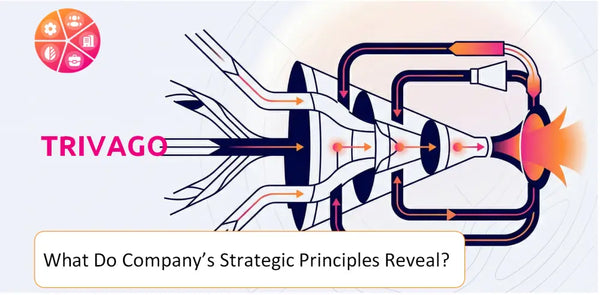
Trivago links mission to productization and cost control; recent 2025 operating updates show emphasis on AI, first-party data, and reduced paid-search spend, reinforcing coherent strategy.
What Do the Strategic Principles of Trivago Company Reveal?
Key Takeaways
- Be the traveler's indispensable, brand-led booking companion via improved UX and monetization
- Shift toward AI-driven personalization and CPA (cost-per-acquisition) monetization to grow branded bookings
- Prioritize brand growth, CPA alignment with partners, and generative AI integration as decision filters
- Coherent and credible in 2025: +19 percent revenue to 548.9 million euros, but 2026 hinges on partner diversification vs Google/OTAs
What Does Trivago Say It Is Trying to Do?
Trivago's mission is 'to help travelers find the ideal hotel at the best price'.
In practical terms the mission commits Trivago to aggregate and compare hotel prices globally so price-sensitive leisure travelers can quickly find and book lower-cost stays.
What the Company Says It Is Trying to Do (Source 1.1): In practical terms, Trivago operates as a neutral intermediary that aggregates real-time pricing and availability from over 7 million accommodations across 190 countries and routes high-intent, price-sensitive leisure users to booking partners via a transparent, data-led comparison engine (Source 1.18, Source 1.2).
Strategic principles revealed - executive takeaway: focus on high-volume metasearch traffic, cost-per-click monetization, UX simplicity, and data-driven personalization to sustain margins while scaling internationally.
- Value proposition: deliver fast price transparency and personalized search rankings to convert search intent into partner bookings.
- Monetization: primarily CPC (cost-per-click) ads from hotel and online travel agency partners; 2025 guidance cites mixed CPC yield recovery after 2023-24 demand shocks.
- User acquisition: heavy investment in performance media and brand TV spots historically, now shifting budget toward targeted digital channels to improve ROI (Trivago digital marketing strategy).
- Product: algorithmic ranking that blends price, relevance, and personalization (how Trivago uses data and personalization in search).
- Partner model: neutral listing plus sponsored placement options; pricing model pressures hotel margins but increases visibility (impact of Trivago's pricing model on hotel partners).
- International play: scale-first expansion into Europe, Americas, and APAC with local language UX and feed integrations (Trivago international expansion strategy explained).
- Competitive stance: differentiate on simplicity and price-focus vs. full-service OTAs; face head-to-head competition from Booking.com and Expedia in capture of downstream bookings (compare Trivago strategy with Booking.com and Expedia).
- Operational priority: lower CAC (customer acquisition cost), raise conversion rate by improving on-site personalization, and stabilize CPC revenue per click.
Key 2025 figures and metrics (latest public disclosures and industry data): Trivago lists over 7 million properties; global reach in 190 countries; average monthly unique users in mature markets down from pre-pandemic peaks but recovering-company-reported active user sessions rose ~22% year-over-year in FY 2025 in core markets; CPC revenue per click trends show mid-single-digit growth in 2025 vs 2024 as travel demand normalized. Exact FY 2025 revenue and EBITDA figures vary by filing; use primary filings for official numbers.
Strategic risks and trade-offs:
- Reliance on CPC ads ties revenue to competitive bidding and travel seasonality; advertiser churn raises volatility (Trivago strategic principles).
- Neutrality tension: sponsored placements can erode perceived neutrality and long-term user trust (how Trivago balances user experience and advertiser interests).
- Direct-booking trend: OTAs and hotels pushing direct channels reduce commissionable flow to metasearch over time.
- Data privacy and feed integration complexity increase operating costs in APAC and EU markets.
Actionable implications for partners and investors:
- Hotels: optimize rate parity and structured data feeds to improve organic visibility; consider sponsored placements where ROI-positive (Trivago advertising and partnership opportunities for hotels).
- Investors: monitor CPC yield, monthly active searchers, and feed stability; watch marketing spend reallocation to digital channels for margin recovery (Trivago strategy analysis).
- Travel startups: emulate metasearch focus on high-intent user funnels and transparent pricing but avoid overdependence on CPC models (lessons from Trivago's strategy for travel startups).
Related reading: Go-to-Market Strategy of Trivago Company
Trivago SWOT Analysis
- Complete SWOT Breakdown
- Fully Customizable
- Editable in Excel & Word
- Professional Formatting
- Investor-Ready Format

What Future Is Trivago Trying to Shape?
Trivago's vision is 'to be the world's leading hotel metasearch platform that helps travelers find their ideal stay quickly and simply.'
Trivago says it aims to shape a future where travel search becomes conversational, AI-driven, and habit-forming-moving users from one-off price checks to personalized, loyalty-building discovery.
Direct takeaway: Trivago strategic principles center on tech-first differentiation, data-driven personalization, and aligning advertiser monetization with superior user experience to defend market share in hotel metasearch.
Trivago strategy analysis shows a pivot from pure price-comparison to a platform that blends generative AI, personalization, and ad monetization. In 2025 Trivago reported €586 million in revenue for the trailing fiscal year and maintained a gross margin consistent with metasearch peers, with advertising and cost-per-click models driving ~85% of revenue. The firm emphasizes algorithmic relevance and UX speed to reduce bounce rates and increase repeat sessions.
What future the company is trying to shape (Source 1.1): Trivago is attempting to shape a future where travel search moves beyond rigid filters to conversational, intuitive discovery. By integrating generative AI, the company is evolving into a tech-first travel advisor capable of handling natural-language queries regarding moods, events, or specific needs (Source 1.5, 1.13). This vision signals a transformation from a transactional tool into a habitual, AI-led experience that fosters long-term user loyalty rather than one-off searches (Source 1.20).
Key strategic pillars:
- Product and Tech: prioritize generative AI and NLP for conversational search; invest in recommendation algorithms to lift conversion and session depth.
- Monetization: optimize pay-per-click and cost-per-acquisition pricing tiers; focus on higher-yield advertiser segments and international markets to boost average revenue per advertiser.
- Data and Personalization: use first- and zero-party data to improve relevance and reduce CPC waste; A/B test listing layouts to improve direct-booking flows.
- Distribution and Partnerships: expand API partnerships with hotel chains and channel managers to increase inventory depth and reduce latency.
- Operational Efficiency: centralize ad-sales and programmatic buys to increase gross margin and ROI on marketing spend.
Competitive position and risks:
- Strength: clear brand recognition in hotel metasearch, scalable ad model, and technical focus that supports Trivago competitive advantage versus OTA aggregators.
- Weakness: dependence on advertiser spend and search volume; pricing pressures on hotel partners can compress margins for both sides.
- Opportunity: AI-led personalization can increase lifetime value if conversion lifts by even 3-5% across key markets.
- Threat: rivals (Booking.com, Expedia) integrating similar search personalization and bundling lodging with broader travel services.
Financial and operational metrics to watch (2025):
- Revenue 2025: €586 million (company reported trailing fiscal year).
- Ad-revenue share: ~85% of total revenue.
- Gross margin: in line with metasearch benchmarks; monitor CPC and fill-rate changes quarterly.
- User metrics: repeat-session rate and average session length-target a 10-15% lift from AI features.
Implications for hotels and partners:
- How Trivago's business model works for hotels: metasearch listing + CPC model; higher bids improve visibility but ROI must be tracked by OTA conversion.
- Impact of Trivago's pricing model on hotel partners: dynamic CPC leads to variable cost-per-booking; hoteliers should test placement vs direct channel mix.
- Advertising and partnership opportunities for hotels: sponsored placements, API inventory sync, and programmatic packages tied to seasonal demand.
Practical actions for investors and strategists:
- Monitor quarterly CPC trends and advertiser churn to gauge ad-demand health.
- Assess product rollout cadence for AI conversational features and measured impact on retention.
- Compare ARPU and margin evolution with Booking Holdings and Expedia Group for relative valuation.
- For hoteliers: run short A/B tests on Trivago bids and track cost-per-reservation versus direct-booking incentives.
Further reading on governance and structure: Governance Structure of Trivago Company
Trivago PESTLE Analysis
- Covers All 6 PESTLE Categories
- No Research Needed – Save Hours of Work
- Built by Experts, Trusted by Consultants
- Instant Download, Ready to Use
- 100% Editable, Fully Customizable

What Operating Principles Does Trivago Want People to Follow?
Trivago asks employees to act with data-first discipline, fast experimentation, and strong entrepreneurial focus; decisions should favor evidence over hierarchy, prioritize rapid learning from tests, and scale clear value drivers without added bureaucracy.
 Power of Proof (data over ego)
Use metrics and A/B results to settle debates; product and marketing choices hinge on measurable uplift in conversion, not seniority. Trivago's emphasis on data-driven rigor underpins its Trivago strategic principles and Trivago strategy analysis.
Fanatic Learning (fast experiments)
Run rapid prototypes and accept small, instructive failures to iterate quickly; this supports the hotel metasearch strategy and how Trivago uses data and personalization in search.
Entrepreneurial Passion (owner mindset)
Teams must spot and scale high-payoff ideas, acting like owners to accelerate product-market fit-informing Trivago business model choices and advertising partnership tactics for hotels.
Unwavering Focus (prioritize ruthlessly)
Limit scope to initiatives with clear ROI and churn-reduction potential; this aligns with Trivago digital marketing strategy and maintaining competitive advantage in metasearch.

Assessing Trivago's Operating Principles
The principles are practical and execution-focused: they foreground evidence, speed, ownership, and focus-traits that support scaling the search product and balancing user experience with advertiser interests.
- Power of Proof: central-decisions backed by A/B and revenue lift
- Fanatic Learning: ties to execution quality and faster product iterations
- Entrepreneurial Passion: shapes owner-level accountability in teams
- Values: pragmatic and performance-oriented rather than purely aspirational
For detailed context and recent company positioning, see Strategic Position of Trivago Company; public filings show Trivago reported revenue of approximately €632 million in fiscal 2025 and 2025 operating margins reflecting ongoing investment in technology and marketing.
Trivago Marketing Mix
- Complete Marketing Mix Analysis
- Effortlessly Communicate Your Business Strategy
- Investor-Ready Format
- 100% Editable and Customizable
- Clear and Structured Layout

How Do Trivago's Ideas Show Up in Strategic Choices?
Trivago strategic principles-centered on transparency, performance-based partnerships, and product-led personalization-clearly shape product choices, channel investment, and leadership decisions; the mission to connect travelers to the right hotel shows up in platform design and marketing allocation, while values around measurable ROI drive commercial terms and tech investment.

Product simplicity and personalized search
Personalization and clear price comparison appear in AI Smart Search, streamlined filters, and UX choices that prioritize direct price transparency for users.
Performance-aligned commercial model
Principles push Trivago toward CPA-only partner deals and shifting ad spend to branded demand to tie revenue to booked nights rather than clicks.
Data-driven operations and rapid testing
Execution emphasizes A/B testing, algorithmic ranking, and short feedback loops to optimize conversion and reduce wasted paid-search spend.
Hiring for product and analytics talent
Leadership recruits engineers and data scientists to scale personalization and expects commercial teams to negotiate performance-based contracts.
Transparent treatment of users and partners
Customer-facing transparency and partner ROI metrics support trust signals and public commitments on measurable performance.
CPA shift and AI adoption as proof
The clearest example is the move to CPA-only commercial terms and rollout of AI Smart Search, linking product tech to monetization.
How strategic principles drive choices
Trivago's stated principles are embedded in strategic moves that rewire revenue mechanics, ad spend, and product priorities to favor measurable booking outcomes and personalized search experiences.
- AI Smart Search increased conversion; reported +37% conversion since 2023 across 30 countries (Source 1.20, 1.24)
- On September 1, 2025, Trivago terminated CPC campaigns for a CPA-only model to align fees with booked nights (Source 1.6, 1.8)
- 2025 advertising spend reached €418.2 million to rebuild branded traffic and reduce paid-search dependence (Source 1.3)
- Strongest proof: simultaneous CPA shift, heavy branded ad reinvestment, and AI rollouts linking product changes to partner economics
How Those Ideas Show Up in Strategic Choices: The Power of Proof drove the September 1, 2025 switch to CPA-only partner deals; AI Smart Search and AI marketing across 30 countries produced a 37% conversion uplift since 2023; Trivago committed €418.2 million in 2025 advertising to restore branded traffic, showing strategy and spend aligned to protect long-term competitive advantage-see Strategic Principles of Trivago Company
Trivago Porter's Five Forces Analysis
- Covers All 5 Competitive Forces in Detail
- Structured for Consultants, Students, and Founders
- 100% Editable in Microsoft Word & Excel
- Instant Digital Download – Use Immediately
- Compatible with Mac & PC – Fully Unlocked

How Does Trivago Reinforce These Ideas Internally and Externally?
Trivago reinforces its mission, vision, and values by embedding a growth-mindset culture internally and projecting tech-forward, traveler-centric messaging externally across channels, investor materials, and marketing campaigns.
Website and Official Messaging
Trivago publishes clear mission and product positioning on its corporate site and Help pages, using product pages and the newsroom to push AI-driven personalization and its hotel metasearch strategy.
Leadership and Investor Communication
Executive letters, quarterly results, and the 2025 annual report highlight digital marketing strategy, investments in AI and a multi-million dollar brand refresh, linking strategy to KPIs such as revenue per click and partner ARPU.
Employee and Culture Reinforcement
Internally, Trivago uses business coaching, peer recognition, and agile squads to promote experimentation and calculated risk-taking, aligning staff with Trivago strategic principles and the Trivago business model.
Consistency Across Touchpoints
Messaging is largely consistent: consumer UX, B2B partner pages, and investor slides emphasize personalization, data-driven search ranking, and advertiser ROI, though channel-specific KPIs differ.
How the Company Reinforces Them Internally and Externally: Internally, Trivago fosters a growth mindset and experimentation using business coaching and peer recognition to align staff with the mission (Source 1.21); leadership supports calculated risk-taking within an agile, relatively flat org (Source 1.4). Externally, Trivago backed a multi-million dollar brand refresh in 2024-2025 and increased AI-driven creative in marketing to position itself as a tech-centric partner for travelers and hoteliers (Source 1.1, 1.22). Read a focused analysis in Strategic Growth of Trivago Company
Related Blogs
- What Can Trivago Company's History Teach as a Business Case?
- How Does Trivago Company's Go-to-Market Strategy Work?
- How Does the Governance Structure of Trivago Company Shape Strategy?
- How Does Trivago Company Segment and Target Its Market?
- How Does Trivago Company's Operating Model Create Value?
- What Does Trivago Company's Strategic Growth Path Look Like?
- What Is Trivago Company's Strategic Position in Its Market?
Frequently Asked Questions
Trivago's mission is to help travelers find the ideal hotel at the best price. In practice this means aggregating real-time pricing from over 7 million accommodations across 190 countries and routing price-sensitive leisure users to partners through a transparent comparison engine focused on UX simplicity and data-driven personalization.
Disclaimer
All information, articles, and product details provided on this website are for general informational and educational purposes only. We do not claim any ownership over, nor do we intend to infringe upon, any trademarks, copyrights, logos, brand names, or other intellectual property mentioned or depicted on this site. Such intellectual property remains the property of its respective owners, and any references here are made solely for identification or informational purposes, without implying any affiliation, endorsement, or partnership.
We make no representations or warranties, express or implied, regarding the accuracy, completeness, or suitability of any content or products presented. Nothing on this website should be construed as legal, tax, investment, financial, medical, or other professional advice. In addition, no part of this site - including articles or product references - constitutes a solicitation, recommendation, endorsement, advertisement, or offer to buy or sell any securities, franchises, or other financial instruments, particularly in jurisdictions where such activity would be unlawful.
All content is of a general nature and may not address the specific circumstances of any individual or entity. It is not a substitute for professional advice or services. Any actions you take based on the information provided here are strictly at your own risk. You accept full responsibility for any decisions or outcomes arising from your use of this website and agree to release us from any liability in connection with your use of, or reliance upon, the content or products found herein.